Building Elite Strength Around Real Life
Building Elite Strength Around Real Life
How a New Father Achieved a 300-Pound Bench Press and 500-Pound Deadlift in Six Months
Executive Summary: Sustainable Strength Training for Busy Professionals
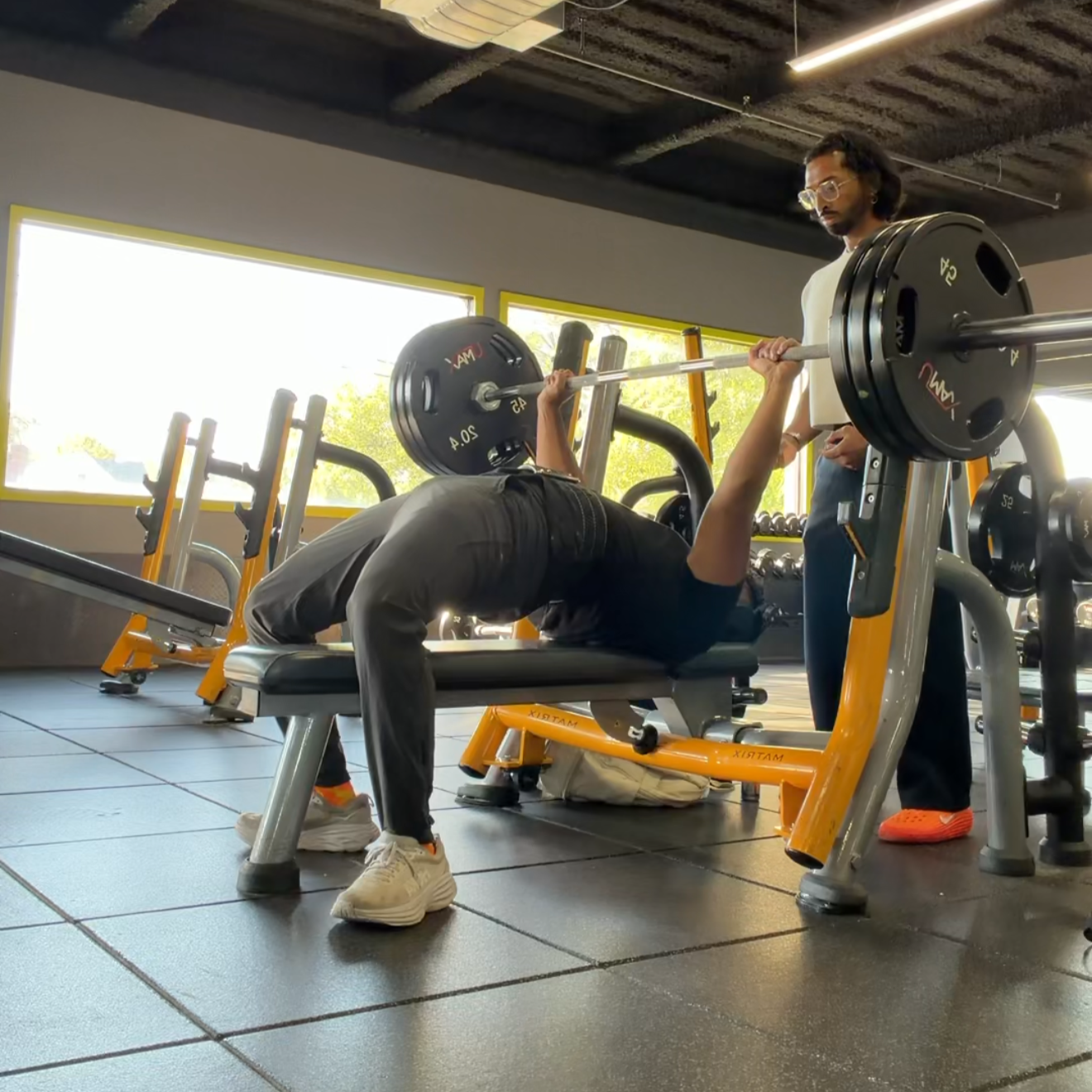
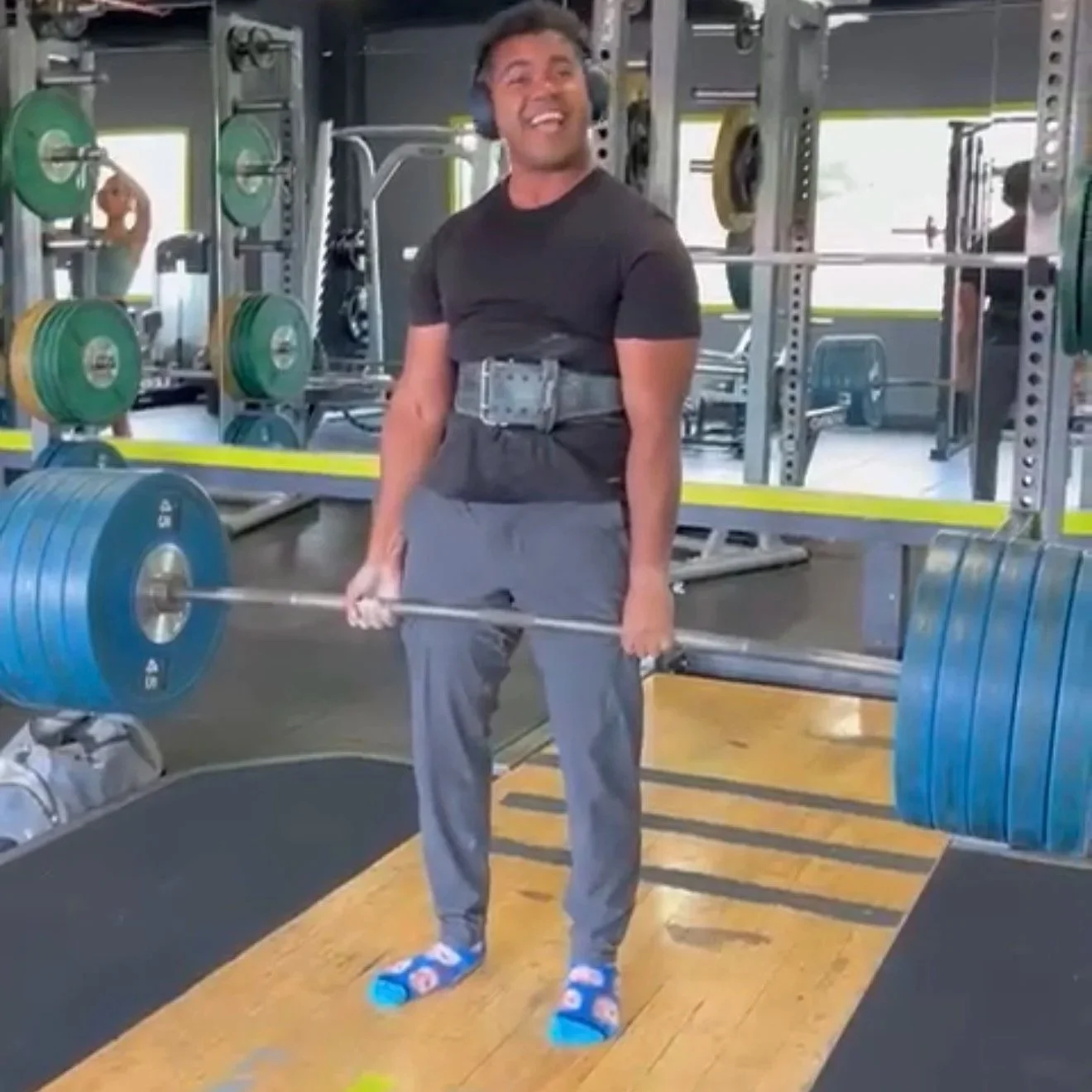
When Sakib, a 34-year-old business analyst and new father, joined Mahir Fitness for personalized strength coaching in Queens, his goals were simple yet ambitious: hit a 500-pound deadlift, reach a 300-pound bench press, and maintain athletic performance for competitive pickleball. The challenge? Balancing newborn care, a demanding NYC career, and frequent travel.
Starting Metrics
Bench Press: 225 lbs × 5
Deadlift: 385 lbs × 6
Training Experience: 10+ years recreational lifting
Training Time: 3 sessions/week, 55 minutes each
Recovery Quality: 5–6/10 (due to newborn sleep disruption)
Six-Month Results
Bench Press: 300 lbs (+33%)
Deadlift: 500 lbs (+30%)
Shoulder Press: +80 lbs
Training Adherence: 76% despite three major travel periods
Average Session RPE: 7–8/10
The Real Challenge: Training Around Real Life
Sakib didn’t need motivation. He needed optimization. Traditional powerlifting programs assumed perfect sleep, schedules, and recovery. Conditions that didn’t exist for a new parent.
Primary Constraints:
Unpredictable recovery (5 hours of sleep on average)
One month-long vacation and two business trips
Weekend pickleball tournaments
Technical inefficiencies in bench press and deadlift setup
The solution wasn’t more volume. It was smarter intent.
The Mahir Fitness Coaching Model: Low Volume, High Intent
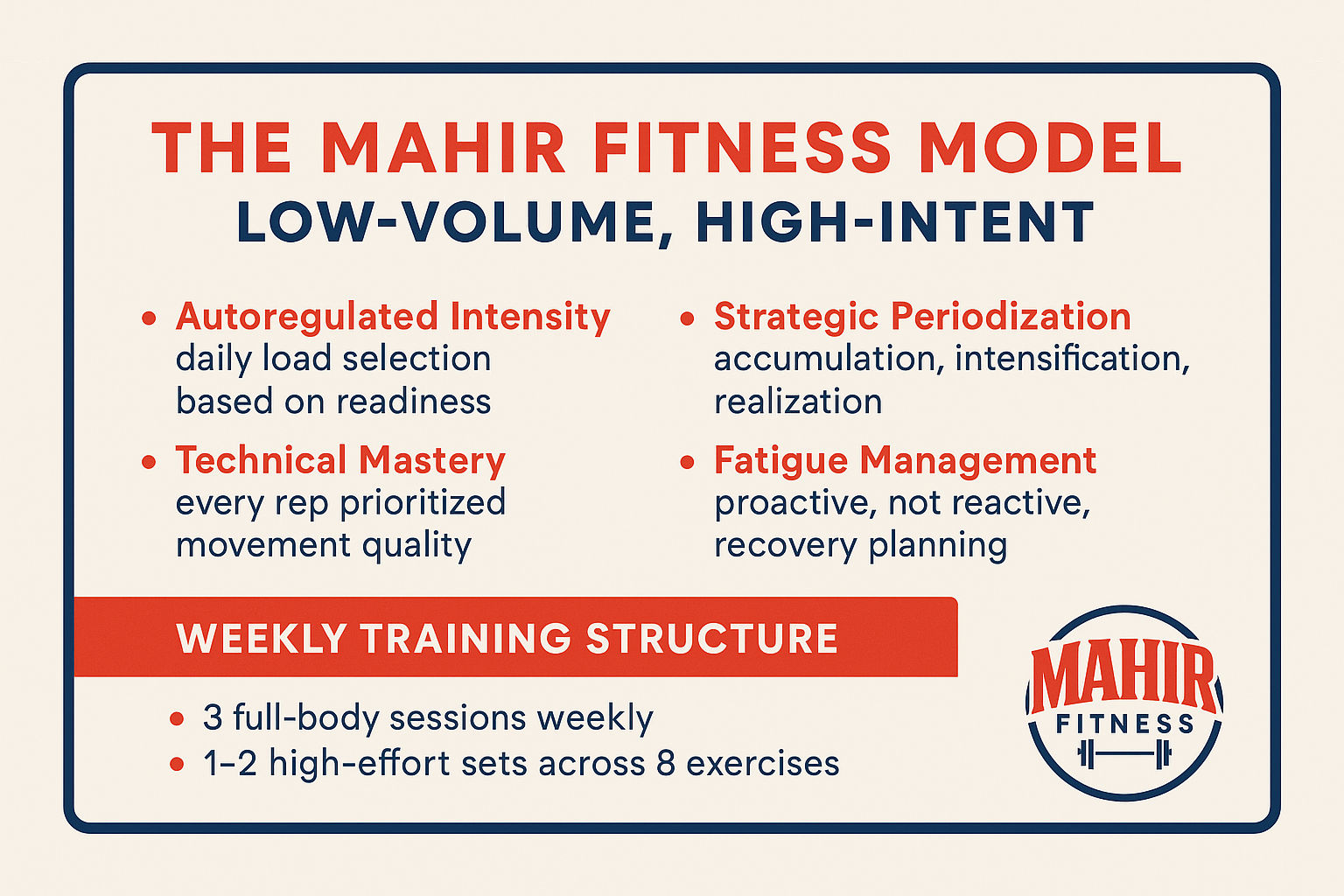
This framework replaced arbitrary volume with deliberate execution.
Programming Principles
Autoregulated Intensity: Loads adjusted to daily readiness and recovery.
Technical Mastery: Every rep treated as skill practice.
Strategic Periodization: Accumulation → Intensification → Realization.
Fatigue Management: Recovery proactively planned, not reactively forced.
Weekly Format
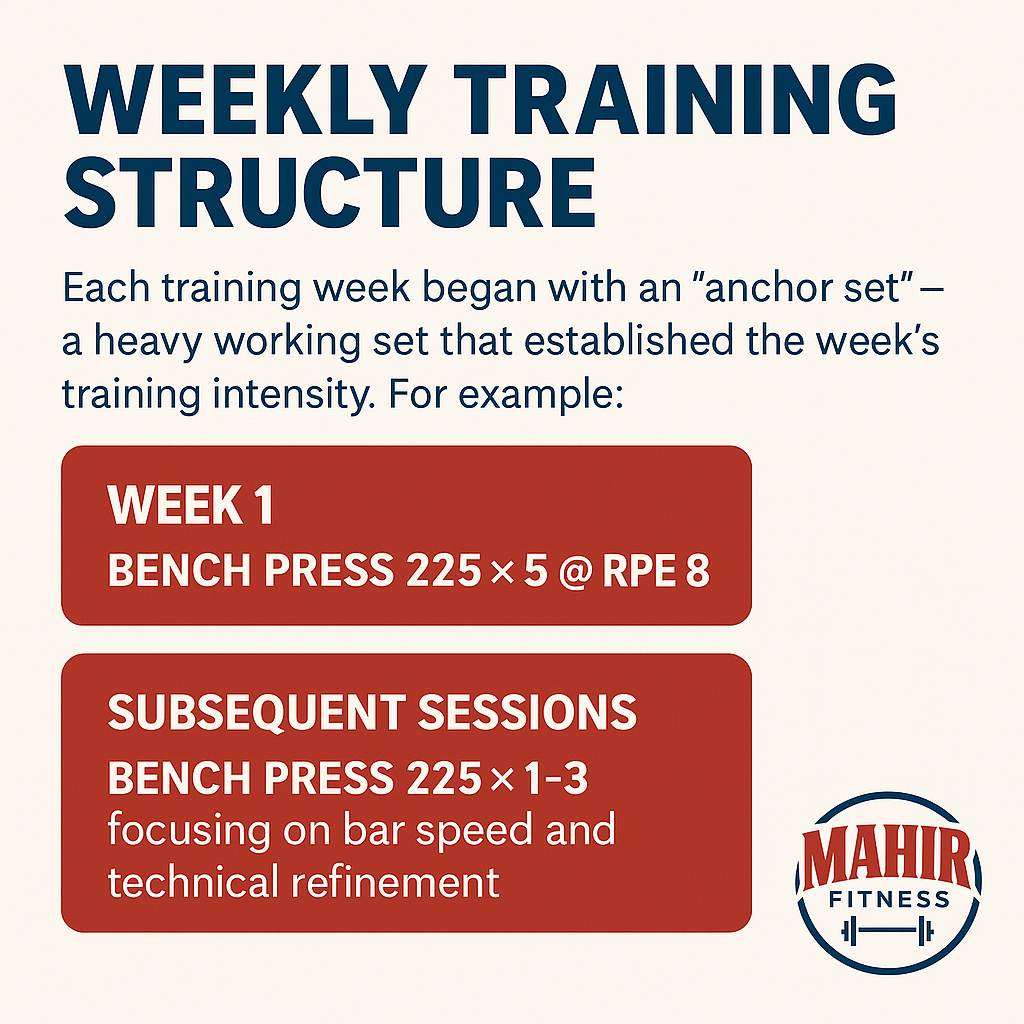
Each week opened with an anchor set to gauge readiness:
Example: Bench Press 225 × 5 @ RPE 8 → next sessions focused on bar speed refinement at 1–3 reps.
This allowed continuous load calibration without burnout.
Core Exercise Selection
Main Lifts:
Bench Press (leg drive & bar path optimization)
Deadlift (bracing & lockout strength)
Overhead Press (shoulder stability)
Accessory Work:
Dumbbell flyes
Triceps extensions
Hyperextensions
Banded lockouts
Phase Breakdown: Strength Built in Three Acts
Phase 1 – Foundation (Weeks 1–6)
Focus: Technical refinement and rhythm building.
Moderate intensity (70–85% 1RM)
Tempo control
Bench path and deadlift bracing drills
Result: Consistency despite sleep disruption.
Phase 2 – Intensification (Weeks 7–12)
Focus: Load progression and recovery planning.
Training density and average intensity increased (80–90% 1RM)
July vacation used as a deload
Breakthrough: 500 lb deadlift achieved in 3 months.
Phase 3 – Realization (Weeks 13–24)
Focus: Peak performance and plateau management.
Heavy doubles and singles
Added fourth “speed day” for bench press
Managed forearm pain via grip width and isometrics
Outcome: 300 lb bench press, breaking a multi-year plateau.
Coaching Infrastructure: How Progress Was Measured
1. Weekly Check-Ins:
Tracked sleep, stress, travel, and pickleball volume via Mahir Fitness’s app.
2. Adaptive Programming:
RPE-based autoregulation replaced fixed percentages.
3. Recovery Reframing:
Vacations became supercompensation phases instead of setbacks.
4. Precision Over Volume:
Every set served a purpose; no wasted reps.
Quantified Results
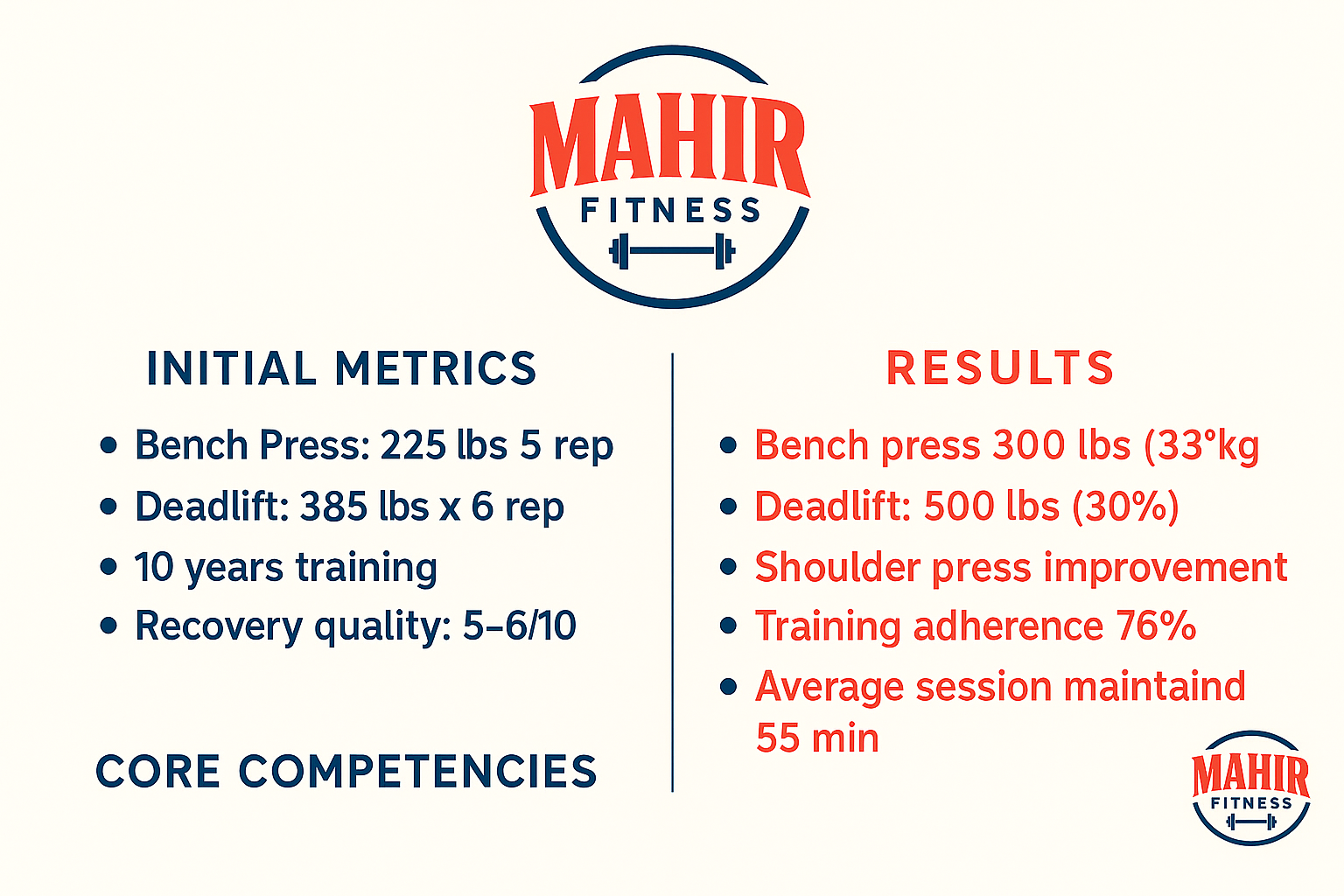
Metric Baseline 3 Months 6 Months % Gain Bench Press 225 × 5 275 × 13 300 × 1 +33% Deadlift 385 × 6 500 × 15 500 × 1 +30% Shoulder Press – +40 +80 – Session Duration 55 min 55 min 55 min – Adherence – 78% 76% – Consistency – – Consistent –
(Infographic: Strength Data Table — Mahir Fitness logo bottom right)
Key Takeaways
For Busy Professionals
55 focused minutes can outperform 2-hour sessions.
Travel doesn’t erase strength—it consolidates it.
Consistency matters more than perfection.
For Coaches
Transparency about life stressors drives real individualization.
Strategic frequency shifts can break plateaus.
Technical precision multiplies load progression.
Client Reflection
“Working with Mahir completely changed my approach to training. I thought being a new father meant delaying my goals. Instead, I hit lifetime PRs on five hours of sleep. The key wasn’t more effort—it was smarter execution.”
— Sakib, Business Analyst & New Father
The Mahir Fitness Difference
Evidence-based programming grounded in exercise physiology.
Flexible structure designed for real-world constraints.
Technical precision that turns training into mastery.
Integrated nutrition and recovery guidance.
Start Your Strength Journey
Whether you’re a busy professional, new parent, or athlete balancing multiple priorities, Mahir Fitness delivers structure that respects your time, recovery, and physiology.
Services:
Strength and conditioning coaching
Nutrition and recovery programming
Exercise physiology consultations
Neurodivergent-friendly training systems
Contact:
Mahir Ahmed, MS, RDN, ACSM-EP
📍Queens & Brooklyn | mahir.fit
📧 mahir.ahmedqa@gmail.com
Works Cited
Zourdos, M. C., et al. (2016). “Autoregulation in resistance training: addressing the inconsistencies.” Journal of Strength and Conditioning Research, 30(6), 1620–1632.
Helms, E. R., et al. (2018). “RPE-based training for strength and hypertrophy: scientific rationale and practical application.” Sports, 6(2), 39.
Grgic, J., et al. (2022). “Effects of resistance training frequency on measures of muscle hypertrophy: a systematic review and meta-analysis.” Sports Medicine, 52, 1–12.
Schoenfeld, B. J., et al. (2021). “Revisiting the role of training volume in resistance training adaptations.” Sports Medicine, 51(2), 231–248.
Dankel, S. J., et al. (2017). “The role of training to failure in resistance training: a meta-analysis.” Journal of Science and Medicine in Sport, 20(7), 653–658.
Pareja-Blanco, F., et al. (2020). “Velocity loss as a variable for monitoring resistance training intensity.” International Journal of Sports Physiology and Performance, 15(6), 750–758.
Schoenfeld, B. J., & Grgic, J. (2020). “Evidence-based guidelines for resistance training volume to maximize muscle hypertrophy.” Frontiers in Physiology, 11, 676.
Haff, G. G., & Triplett, N. T. (2016). Essentials of Strength Training and Conditioning (4th ed.). Human Kinetics.
Behm, D. G., et al. (2021). “Acute and chronic isometric training effects on muscle strength, hypertrophy, and performance.” European Journal of Applied Physiology, 121(2), 525–539.
Gentil, P., et al. (2021). “Minimal effective dose for increasing muscle strength and hypertrophy: a narrative review.” Sports Medicine, 51(7), 1421–1438.